
People
The people of Lesotho are called Basotho, or singular Mosotho. Lesotho's official languages are Sesotho and English, and both are taught in all schools. After fifth year of primary instruction, English becomes the main language in which lessons are taught; this means that most Basotho are able to speak English.
The Basotho people have lived in the area since around 400 CE. Around 1800, King Moshoeshoe I (pronounced mo-shwe-shwe) united many Sotho-Tswana clans into the Basotho nation. Since that time, the term "Basotho" has been extended to mean all the residents of Lesotho, regardless of their ancestry.
Population
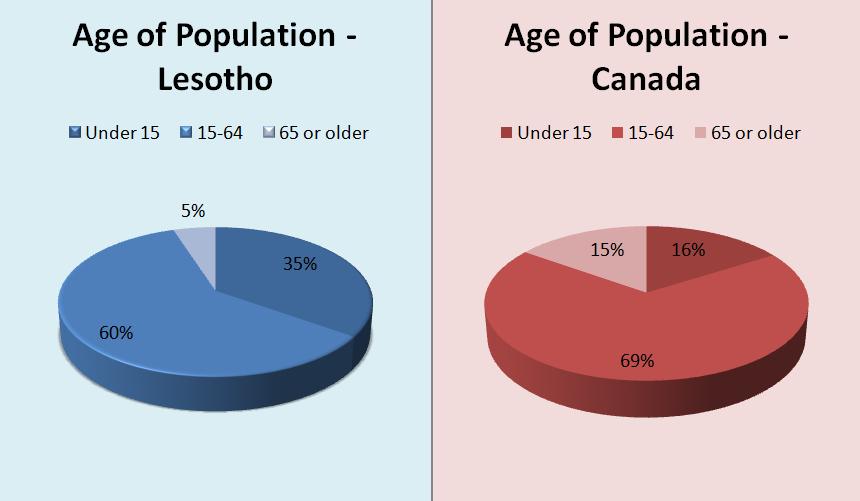
The population of Lesotho is around 2,130,800, but this number can vary due to the low life expectancy and HIV/AIDS mortality rate. About 34.8% are 14 years of age or younger; 60.2% are between 15 and 64, and a mere 5% are over the age of 64. Almost the entire population of Lesotho is Sotho at 99.7%, with the remaining 0.3% being composed of all other ethnicities.
Life expectancy for males is 41.1 years, and for females it is 39.5 years. These low numbers are in great part due to the effect of HIV/AIDS upon the country.
HIV/AIDS
Lesotho has the third highest HIV/AIDS adult prevalence rate in the world at 23.2%. Of the roughly 2 million citizens of Lesotho, 270,000 are currently living with HIV/AIDS and more than 18,000 have already died from it. As Lesotho is the seventh poorest country in the world, it has virtually no means by which to treat the disease.
The deaths are not caused by HIV/AIDS itself. HIV (Human Immunodefficiency Virus) is responsible for causing the immune system to become almost useless, and infections that previously would have been eradicated can now seriously harm the victim. While the deaths are caused by other diseases, any Basotho person will tell you that the people die from HIV/AIDS, as that is the initial cause.
